


Cast Iron vs Steel: Which to Choose for Parts and Why It Matters
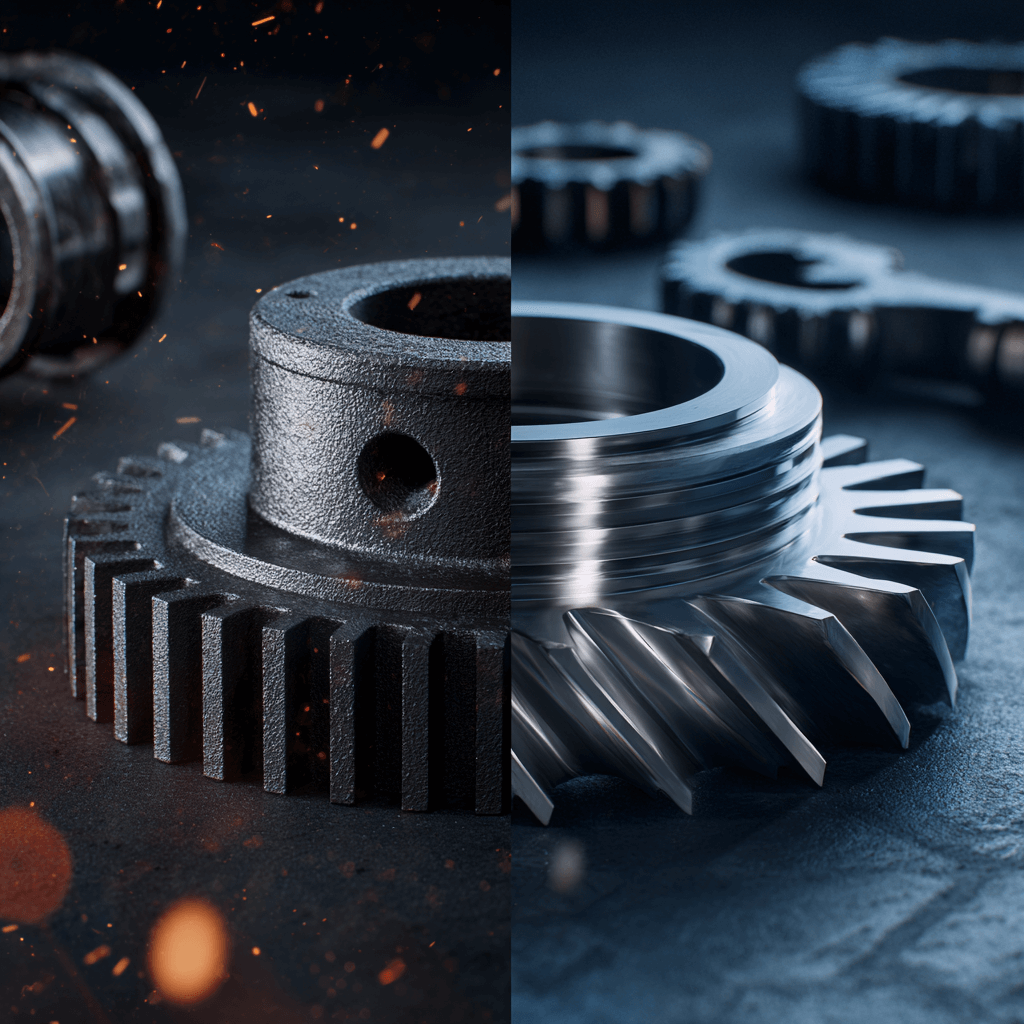
The most common cause of defects, delays and unnecessary costs in the serial production of parts is the wrong choice of material. The customer is often guided by “how it was before”, without taking into account the real loads, working environment and resource requirements. As a result, the part either turns out to be more expensive than necessary, or does not withstand operation.
In this article, we will analyze the difference between cast iron and steel precisely from the perspective of parts production: which is better for housings, which for shock loads, how casting, machining and coating affect, and what is actually tested in the laboratory. The goal is simple: to help you make a technically accurate decision without guesswork.
What is cast iron and steel and where is it used?
Cast iron and steel are both iron-carbon alloys, but with different structures, properties, and behavior in operation. For an engineer, this is important not “in theory,” but in how the part tolerates shocks, abrasion, temperature fluctuations, and vibrations.
Cast iron is usually chosen for large body parts where rigidity and dimensional stability are important. It is good at damping vibrations, often provides high wear resistance in the right conditions, and usually has good castability (the ability to fill a mold and reproduce geometry).
Typical examples: gearbox housings, frames, supports, covers, brackets, pump housings, flywheels, pulleys, armature elements.
Steel is more often chosen for parts that operate under impact or cyclic loading conditions, where increased “survivability” and a margin of safety are required. Steel offers greater control over properties through heat treatment and better tolerates dynamic conditions.
Typical examples: power elements, heavily loaded assemblies, parts subject to shock/jerk, elements where failure is critical and maximum reliability is required.
Cast iron vs steel - briefly and based on facts
In industrial parts, it is important to distinguish between strength, stiffness, and impact strength. These are different characteristics, and this is where confusion often arises.
Stiffness is how much a part deforms under load. Strength is how much load it can withstand before breaking. Impact toughness is how well a material “absorbs” impact energy without suddenly breaking.
Cast iron often excels in stiffness and damping (vibration damping), so housings and frames made of it operate stably. But in shock modes, it can lose out because cast iron is generally more brittle compared to steel.
Steel often wins in terms of impact strength and durability during dynamics. If there are impacts, jerks, and variable loads, a steel part usually provides a higher predictability of service life.
Wear resistance is not always “automatically” better in steel or cast iron. It depends on the grade, structure, friction conditions, the presence of lubrication and the hardness of the surface. In some tasks, cast iron can be a very strong solution, especially for friction pairs and massive assemblies.
Cast iron often has better castability, so complex body shapes are more stable. Steel casting is also widely used, but technologically it is more demanding in terms of modes, power supply, cooling, and defect control.
Comparison of cast iron and steel for parts (quick table)
| Criterion | Cast iron | Steel |
|---|---|---|
| Shock loads | the risk of cracks is higher | usually more reliable |
| Stiffness and damping | strength | less dampened |
| Durability | often high, depends on the brand | high after correct modes/heat treatment |
| Capacity | often more stable for hulls | more demanding casting |
| Behavior at thin sections | risk of brittle fracture | better tolerates local stresses |
| Machining | predictable, but fragility is important | wider selection, but may require heat treatment |
How to choose a material for parts: the logic used by engineers
For a solution to be technically sound, there is no need to “guess.” It is enough to correctly determine the operating mode of the part and critical risks.
Focus on cast iron if the part is solid, massive, rigidity is important, vibration damping is required, there are no sudden shock loads, and the geometry has a complex shape. This is often the best balance of price, stability, and repeatability in a series.
Consider steel for shock, impact, cyclic fatigue, critical reliability, or thin sections where sudden cracking is unavoidable. Steel often provides a greater margin of “survivability,” especially when operating under less than ideal conditions.
Consider not only the material, but also the design. The same material can work well or poorly depending on the geometry. For example, sharp thickness transitions, sharp corners, local stress concentrators can spoil the result even with the correct “cast iron/steel selection”.
What does the production process look like: from application to finished batch
Casting and custom manufacturing of parts is a controlled process where quality is not formed at one stage, but throughout the entire chain.
The first stage is to obtain input data: drawing or 3D model, quantity, material or property requirements, tolerances, machining surfaces, coating and inspection requirements. The more accurate the input data, the lower the risks of defects and deadlines.
The second stage is technological analysis. This is where wall thicknesses, transitions, shrinkage spots, crack risks, and the need for machining allowances are checked. If the part is complex, this is where decisions are made that then determine repeatability in the series.
Next comes production preparation: manufacturing or adapting equipment, preparing molds and technology. After that, melting and pouring metal, cleaning from the sprue system, stripping, and, if necessary, heat treatment.
The next critical stage is machining the parts after casting. This involves providing fits, planes, holes, threads, and surface roughness. After machining, the parts can be painted or otherwise coated.
The final block is quality control and laboratory control: confirmation of the material, verification of properties and compliance with requirements.
Typical problems and how to avoid them: defects and risks
A casting defect rarely occurs “by accident.” It usually has a technical cause that can be identified and eliminated during the preparation stage.
One of the most common problems is cracks. They can be hot (during cooling) or cold (appearing later). Typical causes include sharp thickness transitions, sharp corners, incorrect cooling regimes or high internal stresses. For steel, the risk of cracks can be higher with complex geometry without sufficient technological processing. A practical solution is smooth transitions, radii, correct allowances, agreed regimes and, if necessary, heat treatment.
The second typical problem is shrinkage cavities and porosity. These are defects that can be inside the part or appear on the surface. Their cause is insufficient metal supply during solidification or an incorrect gating system. This is solved by technological development: the correct supply system, control of pouring parameters and compliance with geometry.
The third problem is non-pouring, when the metal does not fill the mold. Causes: too thin walls, insufficient temperature, improper mold ventilation or pouring mode. The solution is to check the minimum thicknesses and technological adaptation.
The fourth problem is deformations after machining. They often appear due to internal stresses after casting, incorrect machining sequence or too thin zones. Correct basing, technological sequence and, in some cases, stabilization/heat treatment help here.
The fifth problem is painting problems: peeling, poor adhesion, corrosion under the coating. Most often, the reason lies in the surface preparation and the incompatibility of the coating system with the operating conditions. The solution is to control the preparation, select the coating for the environment and the requirements for the layer thickness.
What determines the price and production time
The question “how much does it cost to cast custom parts” always depends on the technical input data. But the calculation logic is transparent, and it is worth knowing it so as not to compare incorrect offers.
The price is affected by the material (cast iron or steel), weight and dimensions, complexity of the geometry, need for tooling, batch size, level of machining (number of operations, tolerances, roughness), painting requirements, scope of quality control and laboratory testing, as well as logistics and packaging.
The timing is affected by the readiness of drawings and technical requirements, the need to manufacture/prepare equipment, technological complexity, production workload, as well as documentation and control requirements. The fastest way to reduce timing is not to “speed up the foundries”, but to provide the most complete and correct input data and quickly agree on critical parameters.
Quality control and laboratory testing: what is actually being tested
Laboratory control in foundry production is needed not “for a check mark”, but to confirm the material and reduce risks in the series. Especially if the part operates under load or its failure leads to equipment downtime.
Typically, chemical composition, hardness, metal structure (microstructure), geometry after machining, and, if necessary, the presence of internal defects are checked using non-destructive testing methods. This allows you to explain and confirm why the part has the desired properties, as well as stabilize batch repeatability.
An important practical tip for the customer: record which characteristics are critical and which are secondary. This reduces the cost of control where it does not affect the result, and strengthens control where it is really needed.
How to choose a contractor: a customer checklist
Choosing a contractor is not just about price. For a B2B customer, it is important that the company delivers the predicted results in a series and can explain technological risks.
Check if the full cycle is available: casting, machining, painting, laboratory control. This reduces “liability gaps” when one company pours, another processes, a third paints, and as a result it is difficult to find the cause of deviations.
Find out how they ensure batch repeatability, what typical defects they control for your parts, whether they issue laboratory control reports, and how they work with drawings and tolerances. A good contractor always specifies key parameters, rather than setting a price “by eye”.
A separate criterion is the ability to speak technically: to explain why there may be shrinkage or cracking in a specific geometry, and what is done to avoid this.
Practical scenarios: how to decide between cast iron and steel
Scenario one: gearbox housing or frame. Here rigidity, geometric stability, and vibration damping are important. Often, cast iron is the optimal solution, as it ensures stable operation of housing components and is convenient for mass casting.
Scenario two: a part with shock loading, such as an element that receives jerks or impacts during the operation of a mechanism. Here, steel usually wins due to its better impact strength and lower risk of sudden failure.
Scenario three: serial parts with critical fits. Here, it is not only the choice of “cast iron or steel” that is important, but the combination of material + technology + quality control. It is the combination of stable casting, correct machining and laboratory confirmation of properties that gives a predictable result in batches.
Cast iron or steel, which is better for parts?
Which is better depends on the operating mode. For housings and stable loads, cast iron is often optimal. For shocks, jerks and dynamics, steel is usually more reliable.
What is the difference between cast iron and steel in real operation?
Cast iron is better at damping vibrations and providing rigidity, but can be more brittle under impact. Steel is usually stronger and more impact-resistant, but is more technologically demanding to cast.
What is better for a gearbox housing: cast iron or steel?
In most housing applications, cast iron is often chosen for its rigidity and damping. But if there are impacts or non-standard modes, the solution may shift to steel or another grade.
What material should be chosen for parts with impact loads?
In most cases, steel is a safer choice because it tolerates dynamics better and has higher impact strength.
Why does cast iron crack and how to avoid it?
Common causes are impact modes, sharp thickness transitions, sharp corners, and internal stresses. Correct geometry, technological development, and control of cooling modes help.
How to reduce shortages in iron and steel casting?
Start with a technological analysis of the design, set allowances correctly, coordinate quality control, and do not simplify the shape requirements if the part is complex.
Is machining of parts always necessary after casting?
No, but it is required if there are precise fits, threads, holes, mating surfaces or roughness requirements. For body parts, only functional surfaces are often machined.
How is the quality of cast parts checked in the laboratory?
Typically, the chemical composition, hardness, metal structure, and geometry after processing are monitored. If necessary, internal defects are checked using non-destructive methods.
What determines the price and production time of cast iron and steel parts?
From material, weight, complexity, batch, machining volume, coating and quality control level. Having complete drawings and clear requirements speeds up the process the most.
Is it possible to order casting + machining + painting on a turnkey basis?
Yes, and for mass production, this is often more convenient, because it reduces risks at the process interfaces and simplifies batch acceptance.
Conclusion
The choice between cast iron and steel is not a question of “more expensive/cheaper”, but a question of the right material for specific loads and technology. Cast iron is often best for housings, rigid structures and stable modes, steel often wins in dynamics and under impact. To get a predictable result in a series, evaluate the material together with the process: casting, machining, coating and laboratory control as one technological chain.